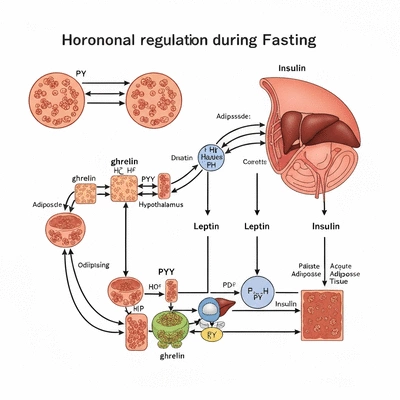
Ghrelin (Hunger Hormone)
Initial Response: Rises sharply, signaling hunger.
Adaptation: Stabilizes or decreases with prolonged fasting, easing hunger pangs over time.
What if the key to managing your appetite lies in understanding the hormonal shifts in your body during fasting? As we dive into the intricate relationship between fasting and hormonal regulation, you'll discover how mastering these dynamics can empower your health journey.
Fasting isn't just about abstaining from food; it's a dynamic interplay of hormones that can reshape your metabolic health and appetite. Below is a summary of how key hunger hormones respond during fasting periods. For a deeper understanding of how these mechanisms contribute to overall well-being, explore our article on hormones, fasting, and weight loss.
Initial Response: Rises sharply, signaling hunger.
Adaptation: Stabilizes or decreases with prolonged fasting, easing hunger pangs over time.
Initial Response: Can decrease due to reduced fat stores.
Long-term: Regular fasting may reset sensitivity, enhancing fullness.
Post-meal: Levels rise after eating, signaling fullness.
Fasting Effects: Modulated during fasting to promote appetite suppression.
Fasting Effect: Decreased secretion, enhancing sensitivity.
Benefit: Lower levels facilitate fat burning and stabilize other hunger hormones.
At Fasting Mechanics, we believe that understanding the intricate relationship between fasting and our hormonal health is vital for anyone looking to improve their metabolic function. One of the key hormonal players in this discussion is ghrelin, often dubbed the "hunger hormone." Let’s dive into how fasting interacts with this hormone and others to sculpt our appetite and satiety.
Ghrelin is produced in the stomach and signals hunger to the brain. When you start fasting, your ghrelin levels can initially spike, leading you to feel hungrier. However, studies indicate that with prolonged fasting, these levels may eventually stabilize or even decrease! This adaptation can help you manage your hunger better over time. To learn more about how fasting can impact your metabolism, read our article on understanding fasting and fat burning.
So, if you’re wondering why you might feel less hungry after a few days of fasting, it’s likely your body adapting to the new eating patterns. Isn’t it fascinating how our bodies can recalibrate?
Now, let’s turn our attention to leptin, another crucial hormone in the hunger equation. Leptin is produced by fat cells and plays a significant role in signaling satiety. When you fast, your leptin levels can decrease, which might sound counterintuitive. After all, we would expect less food intake to lead to less hunger!
Understanding these hormonal shifts can empower you to tailor your fasting approach for better results. Remember, the goal is not merely to endure hunger but to harness these hormonal changes for effective weight management.
Peptide YY (PYY) is another hormone that plays a role in appetite regulation, and it’s secreted in response to food intake. Interestingly, fasting can also affect PYY levels! During fasting periods, PYY can help suppress appetite, making it easier to stick to your fasting protocol.
Incorporating fasting into your routine could adjust your PYY levels favorably, supporting your journey toward weight loss and metabolic health!
Lastly, let's examine insulin, a hormone critical for regulating blood sugar levels. Fasting triggers a decrease in insulin secretion, which can enhance its sensitivity. This is a significant point because lower insulin levels can help facilitate fat burning and decrease hunger. For more insights on how fasting improves insulin sensitivity, check out our guide on fasting's role in insulin sensitivity.
By understanding how insulin fits into the fasting puzzle, you’ll see how this hormonal shift can support your health goals. It’s incredibly rewarding to witness how our bodies respond to fasting in such nuanced ways!
As we explore further, it’s essential to recognize that different fasting methods can yield varying hormonal responses. Understanding these differences can guide you in choosing the best fasting approach for your lifestyle and goals.
We’d love to hear from you! What has been your biggest challenge with fasting? Choose one of the options below:
A: Initially, ghrelin levels can spike during fasting, causing increased hunger. However, with prolonged fasting, these levels often stabilize or decrease, helping to manage hunger over time as the body adapts.
A: Leptin, the satiety hormone, may decrease during fasting due to reduced fat stores, which could initially lead to increased appetite. However, regular fasting can improve leptin sensitivity, enhancing feelings of fullness in the long term.
A: Peptide YY (PYY) is a hormone that signals fullness after eating. During fasting, PYY levels can be modulated to promote appetite suppression, making it easier to adhere to a fasting protocol.
A: Yes, fasting significantly decreases insulin secretion, which in turn enhances insulin sensitivity. Lower insulin levels facilitate fat burning and help stabilize other hunger hormones, contributing to better metabolic health.
A: Effective strategies include staying well-hydrated, focusing on nutrient-dense foods during eating windows, keeping busy to distract from hunger, and gradually increasing fasting durations to allow your body to adjust.
As we’ve explored, fasting plays a pivotal role in regulating various hunger hormones, including ghrelin, leptin, and PYY. Ghrelin, known as the hunger hormone, typically increases during fasting, signaling your body to seek food. However, with time, fasting can lead to adjusted ghrelin levels, helping to manage appetite effectively.
Meanwhile, leptin, which helps convey feelings of satiety, often sees fluctuating levels that can aid in weight management during fasting. Additionally, PYY levels rise during fasting, contributing to appetite suppression. Understanding these hormonal dynamics can empower you to make informed decisions about your fasting practices.
In summary, fasting isn’t just about not eating; it’s a complex interaction of hormones that can help you manage your hunger effectively. By acknowledging how these hormones function, you can better navigate your fasting journey!
Feeling hungry during your fasting periods? You're not alone! Managing hunger is a common challenge, but there are practical strategies that can help you stay on track. Here are some tips I've found beneficial when guiding others through their fasting journeys:
By implementing these strategies, you can effectively manage hunger and make your fasting experience more comfortable. Remember, it’s all about finding what works for you and listening to your body. Fasting should feel empowering, not overwhelming!
The journey into the world of fasting and its effects on hormonal health is just beginning. At Fasting Mechanics, we strive to provide comprehensive insights into the science behind fasting. We invite you to explore more research-backed articles and resources that can enhance your understanding of this fascinating topic. For example, delve into understanding metabolic flexibility and fasting to further your knowledge.
Have questions or need guidance on your fasting journey? I'm here to help! Engaging with the community, whether through discussions or personal experiences, can enrich your knowledge and motivate you to embrace fasting as a tool for better health. Let’s discover the transformative benefits of fasting together!
Here is a quick recap of the important points discussed in the article:
Dr. Avery R. Lawson is an independent health researcher dedicated to making complex metabolic and nutrition science accessible. With a focus on the physiological effects of fasting, she interprets and communicates research findings to empower individuals in their health journeys. Through evidence-based insights, Dr. Lawson aims to demystify weight loss and promote sustainable wellness practices at Fasting Mechanics.